Northeast China
Liaoning Hongshan Period Communities Project
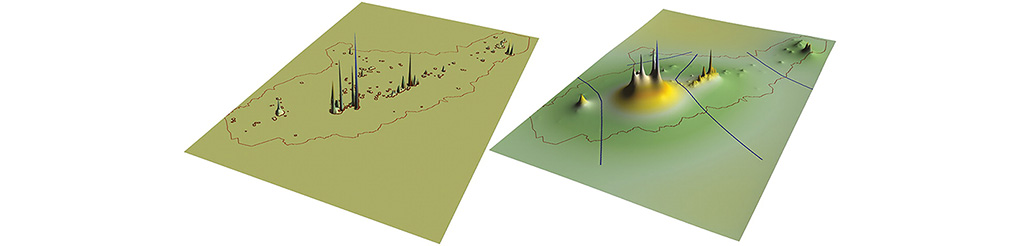
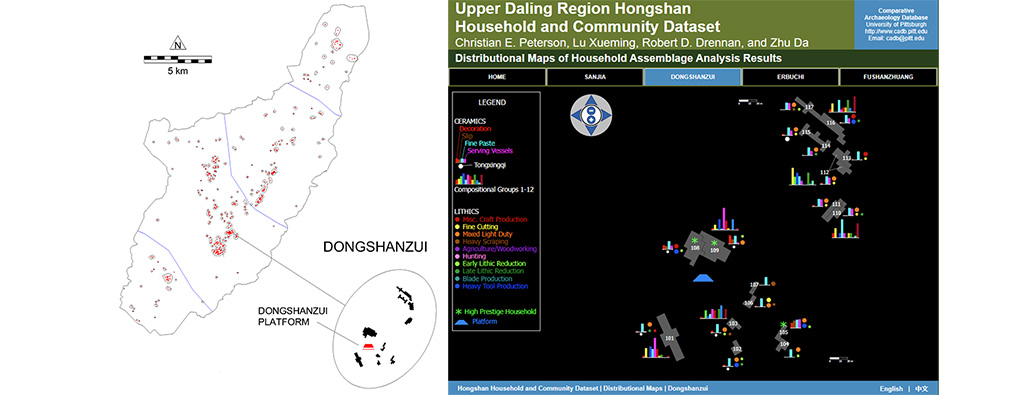
The Liaoning Hongshan Period Communities Project (LHPCP) focused on the emergence and development of Hongshan (4500–3000 BCE) chiefly communities. Data collection in the area surrounding Niuheliang included regional-scale settlement survey and study of local communities and households through intensive surface collection and small-scale stratigraphic testing. Similar fieldwork and lab analysis in the Upper Daling region was carried out from 2007 to 2014. The objective was to document the nature of human organization at household, local community, regional polity, and macro-regional scales so as to understand better the societies that produced the ceremonial architecture and elaborate burials that have attracted considerable archaeological attention. Principal collaborators were Robert D. Drennan and Lu Xueming. The project was an institutional collaboration between the University of Hawai’i, the University of Pittsburgh, Renmin University of China, and the Liaoning Province Institute of Archaeology. Funding was provided by the National Science Foundation, the National Geographic Society, the Henry Luce Foundation/ACLS, the University of Hawai’i at Manoa, the University of Pittsburgh, and Renmin University of China. It produced doctoral dissertations by Li Tao, Ran Weiyu, Chen Hsi-wen, and Ma Zhiguo.
While analysis of the data collected by the project is ongoing and additional publications are forthcoming, no further fieldwork is planned.